
Top 10 Chemical Supplier Companies in Saudi Arabia: Updated List
Looking for the best chemical supplier companies in KSA? This guide lists the 10 Saudi chemical companies buyers ask about most, from large producers like SABIC to local distributors like Chemadd by AlSarif Company of Building Materials. For each one, you’ll see where it works, what it sells, who started it, when it began, and how long it has been running.
What you’ll get from this article
-
- A clear list of the top 10 chemical companies in Saudi Arabia, with the same five facts for each: location, products, founder, year started, and experience.
-
- The simple difference between a producer and a distributor, and which one you should call.
-
- A table that matches each type of supplier to your monthly order size.
-
- The full cost of buying chemicals in the Kingdom, not just the price on the quote.
-
- A 7-step checklist to check any supplier before your first order.
Producer or distributor: which kind of supplier do you need?
Most buyers under a few hundred tonnes a month need a distributor, not a producer. A chemical manufacturing company makes chemicals in its own plants and sells mainly in bulk. A chemical distributor firm buys from producers, holds stock, and resells in smaller lots with documentation and delivery. An industrial chemical supplier of this kind buys from producers, holds stock, and resells in smaller lots with documentation and delivery.
The split matters more in Saudi Arabia than in most markets. The Kingdom has about 120 million tonnes a year of petrochemical capacity, mostly in Jubail and Yanbu, according to Germany Trade & Invest (GTAI), January 2026. Around 90% of that capacity is bulk chemicals, common plastics and fertilizers. Specialty chemicals are only about 10% of capacity but more than a third of industry revenue, per GPCA estimates cited by GTAI.
That’s why the Kingdom imports so much. Saudi chemical imports rose from about US$21.9 billion in 2023 to US$24.3 billion in 2024 (UN Comtrade data, via GTAI). Many of the pigments, additives, and resins a formulator needs aren’t made locally at all. They arrive through distributors.
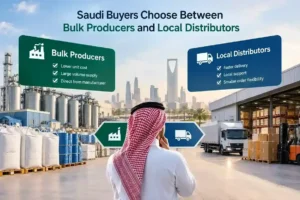
List of Top 10 Chemical Supplier Companies in Saudi Arabia
This ranking weighs how useful each of these Saudi chemical companies is to a buyer looking for a supplier, not revenue alone.. Producers are here because they make the material or set prices. Distributors are here because they serve smaller, mixed orders. Each company below has the same five facts, checked against its own website or a trusted news or business source.
1. SABIC (Saudi Basic Industries Corporation)
SABIC sets the pace for the whole market.
-
- Location presence areas: Head office in Riyadh. Most Saudi plants are in Jubail Industrial City, with others in Yanbu and Dammam. Worldwide, it lists about 60 plants in more than 40 countries.
-
- Services or products provided: Plastics such as polyethylene and polypropylene, base chemicals, and fertilizers through SABIC Agri-Nutrients. It sells mainly in bulk, under contract.
-
- Founder: Set up by Saudi royal decree in 1976. Its first chairman was Ghazi Abdul Rahman Al Gosaibi, and its first CEO was Abdulaziz bin Abdullah Al Zamil. Saudi Aramco has owned 70% since 2020.
-
- Year of establishment: 1976.
-
- Location and experience: 50 years in Riyadh.
Best for: factories buying plastics or base chemicals at plant scale. Not for: a 2-tonne mixed order.
2. Chemadd
Chemadd is a Riyadh chemical distributor and industrial chemical supplier that supplies raw materials to factories that mix their own products, such as paint, mortar, detergent, and plastics makers.
-
- Location presence areas: Head office in Al Sali, Riyadh. It delivers across the Kingdom, including Jeddah, Dammam, and the Eastern Province.
-
- Services or products provided: Iron oxide pigments, including BAYFERROX grades; construction chemicals such as redispersible polymer powder, HPMC, and admixtures; detergent raw materials such as LABSA and SLES; paint and coating resins and additives; industrial raw materials such as solvents and glycols; and plastic additives. Orders come with a Certificate of Analysis, Safety Data Sheet, Certificate of Origin, and technical data sheets, and quotes usually go out within 24 hours.
-
- Founder: Not named on its website. Chemadd is part of the ALSARIF Group, which it describes as an established Saudi industrial group.
-
- Year of establishment: Since 2015, when it started sales and distribution in the Kingdom.
-
- Location and experience: About 11 years of supplying from Riyadh. It lists itself as an authorized distributor for BAYFERROX pigments and Lanxess, and it has exhibited at Saudi Big 5 and Saudi Build.
Best for: buyers who need several materials from one supplier, with papers that prove where each batch came from.
Keep in mind: it’s a distributor, so a producer contract will usually be cheaper for thousands of tonnes of one plastic. Its site doesn’t list ISO certificates, so ask for quality documents if your customers need them.
3. Sadara Chemical Company
Sadara is one of the largest single chemical sites in the Kingdom, built as a partnership between two global names.
-
- Location presence areas: Jubail Industrial City, next to PlasChem Park, with 26 plants (Sadara).
-
- Services or products provided: Polyethylene, polyols, isocyanates, glycols, and elastomers, which go into foam, coatings, and plastics. SABIC now markets some Sadara products.
-
- Founder: Saudi Aramco and The Dow Chemical Company, as a joint venture first announced in 2007.
-
- Year of establishment: October 2011.
-
- Location and experience: About 15 years in Jubail.
Best for: foam and polyurethane makers buying at volume.
4. Sipchem (Sahara International Petrochemical Company)
Sipchem is a listed Saudi producer known for solvents, acetic products, and EVA.
-
- Location presence areas: Head office in Al Khobar, with its plant complex in Jubail (Wikipedia).
-
- Products & Services: Methanol, butanediol, tetrahydrofuran, acetic acid, acetic anhydride, vinyl acetate monomer, and EVA (Resinex).
-
- Founder: Private-sector investors from Saudi Arabia and other GCC countries. Our sources don’t name one founder.
-
- Year of establishment: 22 December 1999.
-
- Location and experience: About 27 years.
Best for: buyers of solvents, acetic products, and EVA at volume.
5. Tasnee (National Industrialization Company)
Tasnee is a Riyadh industrial group with interests in plastics, chemicals, and titanium dioxide.
-
- Location presence areas: Head office at Business Gate, Western Ring Road, Riyadh (Mubasher). Its main markets include Saudi Arabia, Australia, the US, Europe, the Middle East, and Asia.
-
- Services or products provided: Ethylene, polyethylene, propylene, polypropylene and acrylic acid, plus batteries, lead, plastic products and acrylic sheets. Its Cristal unit, 79% owned by Tasnee, holds a 24% stake in Tronox, a titanium dioxide maker (Argaam).
-
- Founder: Not named in the sources we checked.
-
- Year of establishment: May 1985. Listed on Tadawul since January 1993.
-
- Location and experience: About 41 years in Riyadh.
Best for: large buyers in the plastics and titanium dioxide supply chain.
6. Juffali Chemicals (E. A. Juffali & Brothers)
If you searched مصنع الجفالي for chemicals, this is the business you want. Juffali is one of the oldest family groups in the Kingdom.
-
- Location presence areas: Group head office in Jeddah (Juffali). Its distribution venture with Univar was set up with its base in the Eastern Province.
-
- Services or products provided: Dow products through Juffali Chemicals; chemicals for personal care, oil and gas, food, coatings and cleaning through Juffali Univar; polystyrene, insulation and latex through Juffali Arabian Chemical Company, a Dow joint venture; and pumps through Juffali ProMinent.
-
- Founder: The Juffali family. Our sources don’t name a single founder. Sheik Ahmed bin Abdullah Al-Juffali (1924 to 1994) led the group’s growth.
-
- Year of establishment: The group was established in 1946; Juffali Chemicals in 1976.
-
- Location and experience: 80 years for the group in Jeddah, and 50 years in chemicals.
Best for: buyers who want Dow-made materials through a long-standing local partner.
7. Petro Rabigh (Rabigh Refining & Petrochemical Company)
Petro Rabigh combines an oil refinery and a chemical plant on one site.
-
- Location presence areas: Rabigh, on the Red Sea coast north of Jeddah.
-
- Services or products provided: Fuels and petrochemicals used in plastics, detergents, lubricants, resins, coatings, and packaging. It says it’s the only propylene oxide producer in the Middle East.
-
- Founder: Saudi Aramco and Sumitomo Chemical, as a joint venture.
-
- Year of establishment: 2005.
-
- Location and experience: About 21 years in Rabigh.
Best for: western-region buyers of bulk plastics.
8. SABIC Agri-Nutrients
SABIC Agri-Nutrients is the fertilizer arm of SABIC, the Kingdom’s oldest petrochemical company.
-
- Location presence areas: Head office in Riyadh, with an affiliate, Al-Jubail Fertilizer Company. It sells in markets including the US and Africa (Saudipedia).
-
- Services or products provided: Urea, ammonia, phosphate fertilizers, and other nitrogen-based products.
-
- Founder: Started as the Saudi Arabian Fertilizer Company (SAFCO), a joint venture between the Saudi government and Saudi citizens. It’s now part of SABIC.
-
- Year of establishment: 1965, as SAFCO.
-
- Location and experience: About 61 years. It was the most profitable listed Saudi petrochemical company in the first half of 2026.
Best for: farm suppliers and buyers of urea or ammonia.
9. Brenntag with Al-Azzaz Chemicals
This is a partnership between Brenntag, a large German chemical distributor, and Al-Azzaz Chemicals, a Saudi specialty distributor.
-
- Location presence areas: Riyadh, Jeddah, and Al Khobar/Dammam .
-
- Services or products provided: Specialty chemicals for food and pharma, plastic and material additives, and petrochemicals.
-
- Founder: Not named in our sources. Al-Azzaz Chemicals belongs to Al-Azzaz Holding, whose CEO in 2022 was Fahad Al-Azzaz
-
- Year of establishment: Al-Azzaz Chemicals was established in 1984. The 75/25 joint venture with Brenntag was expected to close in August 2022.
-
- Location and experience: About 42 years for Al-Azzaz in the Kingdom.
Best for: food, pharma, and specialty buyers.
10. Henkel Polybit
Henkel Polybit makes ready-to-use building products rather than raw chemicals.
-
- Location presence areas: A production site in Dammam (GTAI, 2026), offices across the GCC, and factories in the UAE, Saudi Arabia, and Egypt. Its head office is in Ras Al Khaimah, UAE (ProTenders).
-
- Services or products provided: Waterproofing, tile adhesives, flooring, thermal insulation, and other construction chemicals.
-
- Founder: Polybit’s founder isn’t named in our sources. Polybit formed a joint venture with Henkel in 2004; Henkel itself was founded by Fritz Henkel in 1876.
-
- Year of establishment: 2004 as Henkel Polybit. Polybit’s own start date isn’t confirmed.
-
- Location and experience: More than 22 years as Henkel Polybit across the Gulf.
Best for: contractors who want a finished, branded product instead of raw materials.
Comparison of Top 10 chemical supplier companies in Saudi Arabia by type, base, & products
| # | Company | Type | Base | Core products | Best fit |
|---|---|---|---|---|---|
| 1 | SABIC | Producer | Riyadh | Polymers, base chemicals | Plant-scale contracts |
| 2 | Chemadd | Distributor | Riyadh | Pigments, construction, detergent, coating raw materials, plastic additives | Formulators needing mixed orders with COA and SDS |
| 3 | Sadara | Producer (Aramco/Dow JV) | Jubail | PE, polyols, isocyanates, glycols | Polyurethane producers |
| 4 | Sipchem | Producer | Al Khobar / Jubail | Methanol, acetyls, VAM, EVA | Solvent and EVA buyers at volume |
| 5 | Tasnee | Producer / holding | Riyadh | Petrochemicals, TiO2 link via Tronox | Large chain buyers |
| 6 | Juffali Chemicals | Distributor + JV maker | Jeddah | Dow products, polystyrene, latex | Dow-origin materials |
| 7 | Petro Rabigh | Producer | Rabigh | Bulk polymers | Western-region bulk |
| 8 | SABIC Agri-Nutrients | Producer | Saudi Arabia | Fertilizers | Agriculture |
| 9 | Brenntag / Al-Azzaz | Distributor | Riyadh, Jeddah, Khobar | Food, pharma, additives | Specialty ingredients |
| 10 | Henkel Polybit | Producer | Dammam | Finished construction chemicals | Contractors |
In our review of these ten companies’ public pages for this guide, the producers talk about plants and product families, while only the distributors talk about delivery cities and document packs. That difference tells you who is set up to serve a small or mid-size buyer. Bookmark the table; it’s the quickest way to shortlist.
Chemical suppliers in Jeddah
Jeddah buyers have a few practical options. Juffali Chemicals is headquartered in Jeddah and offers Dow-origin materials through a long-standing local partner. Brenntag, with Al-Azzaz Chemicals, serves Riyadh, Jeddah, and Al Khobar/Dammam with specialty and additive grades. Chemadd, based in Riyadh, delivers to Jeddah with a Certificate of Analysis, Safety Data Sheet, and Certificate of Origin with each order. For bulk plastics, Petro Rabigh sits on the Red Sea coast north of the city. Ask any supplier for delivered, duty-paid prices to Jeddah before you compare quotes.
Which supplier fits your order size?
Your monthly volume decides the right route more than any brand name does. The bands below are working rules of thumb from how producers and distributors present their offer, not fixed industry thresholds.
| Monthly volume | Typical buyer | Best route | Why |
|---|---|---|---|
| Under 5 tonnes, many SKUs | Small paint shop, cleaning-products start-up, contractor | Local distributor (Chemadd, Brenntag/Al-Azzaz) | One invoice, small lots, documents included |
| 5 to 100 tonnes | Mid-size formulator in Riyadh, Jeddah or Dammam | Distributor contract with fixed lead times | Distributor holds stock; you avoid producer minimums |
| Over 100 tonnes of one product | Converter, large plant | Producer or its appointed marketer (SABIC, Sadara, Sipchem) | Bulk prices and secure supply |
Scale changes the risk, too. For a small buyer, the danger is a supplier that runs out. For a large buyer, it’s a single-source contract with no backup. Plants above 100 tonnes a month usually keep a distributor as a second source anyway.
What if the biggest producer won’t sell to you?
Go to an authorized distributor of that producer’s brand. That’s the normal route, not a workaround. Ask the distributor for its authorization letter, then buy the same origin material in the lot size you need.
The popular advice to “buy direct from the manufacturer” fails for most buyers under bulk volume. It also fails when you need materials Saudi plants don’t make, such as many specialty pigments and additives.
Buying direct from a producer
-
- Pros: lowest unit price at volume; priority when stock is short; direct technical service.
-
- Cons: high minimums; slow account setup; one product family per contract; little help with mixed orders.
Buying from a distributor
-
- Pros: small and mixed lots; local stock; faster quotes; one document pack across suppliers.
-
- Cons: a margin on top of producer price; quality depends on the distributor’s sourcing; check authorization before you rely on “genuine” claims.
What does a chemical really cost you in Saudi Arabia?
The invoice price is only part of the cost. Your real cost is the price per kilogram plus tax, paperwork, delivery, storage, and the cost of a bad or late batch.
For paint and construction-chemical formulators, the trade-off often comes down to a slightly higher price per tonne against the cost of one stopped production line. Account for these items before comparing quotes:
-
- VAT: 15% on most sales in the Kingdom; confirm the supplier’s VAT number appears on the invoice.
-
- Customs and conformity on imports: duty depends on the HS code, and regulated products may need SABER certificates from SASO. Ask whether the price is duty-paid.
-
- Freight: Jubail and Yanbu are hundreds of kilometers from Riyadh. A delivered price beats ex-works for most small buyers.
-
- Storage and shelf life: HPMC, polymer powders and emulsions degrade if stored badly. Buying smaller, more often can cost less than holding stock.
-
- Failed batches: one off-spec lot can cost more than a year of price savings. That’s why the COA matters.
Pricing, duties, and rules change. Get a written quote and verify current terms on each supplier’s official website or with their sales team.
How do you vet a chemical supplier in KSA?
A supplier is worth shortlisting only if it passes basic document and stock checks. Use this list before you place a first order:
-
- Check the commercial registration (CR) and VAT number on the quote.
-
- Ask for the producer’s authorization letter if the supplier claims a brand.
-
- Request a Certificate of Analysis tied to the batch or lot number you’ll receive.
-
- Get the current Safety Data Sheet and technical data sheet for each product.
-
- Ask for a Certificate of Origin to confirm where the material was made.
-
- Get stock location and lead time in writing, including for repeat orders.
-
- Test a sample, then a small trial batch, before signing a volume contract.
Among the supplier pages we reviewed for this guide, Chemadd’s spells out its document pack (COA, SDS, origin, and TDS); with most producers, you’ll have to ask. Save this checklist for your next quote round.
Common mistakes Saudi buyers make
-
- Choosing by brand size. The biggest producer is often the hardest to buy from at small volume.
-
- Comparing ex-works with delivered prices. Always compare like for like.
-
- Skipping the trial batch. Pigment shade and polymer powder performance vary between grades.
-
- Relying on one supplier. Even large plants need a backup supplier.
Pick by fit, not fame
The top chemical supplier companies in Saudi Arabia fall into two camps, and the right one depends on your volume. If you buy hundreds of tonnes of one polymer or base chemical each month, talk to producers such as SABIC, Sadara or Sipchem, or their appointed marketers. If you buy smaller, mixed orders of pigments, construction chemicals, detergent raw materials or additives, an authorized distributor will usually serve you faster, with better paperwork and less stock risk.
Whichever route you take, insist on a batch COA, a current SDS and proof of origin before you sign. Shortlist two suppliers from the table above, send both the same written inquiry, and compare delivered, duty-paid prices.
If you’re a Riyadh formulator, Chemadd’s product pages are a sensible place to start that comparison, and you can request a quote when you’re ready.
Frequently asked questions about chemical suppliers in Saudi Arabia
What is the difference between a chemical manufacturer and a chemical supplier?
A manufacturer makes chemicals in its own plants. A supplier is anyone who sells them to you, which includes distributors who buy from manufacturers and resell in smaller lots. In Saudi Arabia, manufacturers such as Sadara and Sipchem sell mainly in bulk, while distributors handle mixed and smaller orders with local stock.
Which chemical suppliers in Jeddah can serve small and mid-size buyers?
Distributors are the better fit. Chemadd delivers there from Riyadh. Ask for written lead times and a document pack before ordering.
Which chemical suppliers deliver in Riyadh?
Distributors based in or serving Riyadh are the practical choice. Chemadd is based in Riyadh and delivers Kingdom-wide, and also covers Riyadh, Jeddah, and Al Khobar. Ask any supplier for delivered prices and lead times in writing before you order.
What documents should a chemical supplier provide?
At minimum, ask for a Certificate of Analysis tied to your batch, a current Safety Data Sheet, and a technical data sheet. For imported or branded material, also ask for a Certificate of Origin and the producer’s authorization letter. These protect you if a batch fails or a customer audits your sourcing.
What is a Certificate of Analysis?
A Certificate of Analysis is a document that shows the measured test results for a specific batch of a chemical, compared with its specification. It tells you whether the lot you received matches what you ordered. Always check that the batch number on the certificate matches the number on the bags or drums.
How do I compare chemical supplier quotes in Saudi Arabia?
Compare delivered, duty-paid prices, not ex-works. Add 15% VAT, freight from the stock location, any customs or SABER costs on imports, and the lead time. Then weigh document quality and stock reliability. A slightly higher price from a supplier who never runs out often costs less overall.
How often should I review my chemical supplier?
Review at least once a year, and sooner if lead times slip or a batch fails. Re-quote with two suppliers, check that documents are still current, and confirm any brand authorizations. Market conditions in Saudi petrochemicals shifted noticeably in 2025 and 2026, so last year’s price may no longer be competitive.